
Beyond Boundaries: UNESCO Biosphere Regions in BC
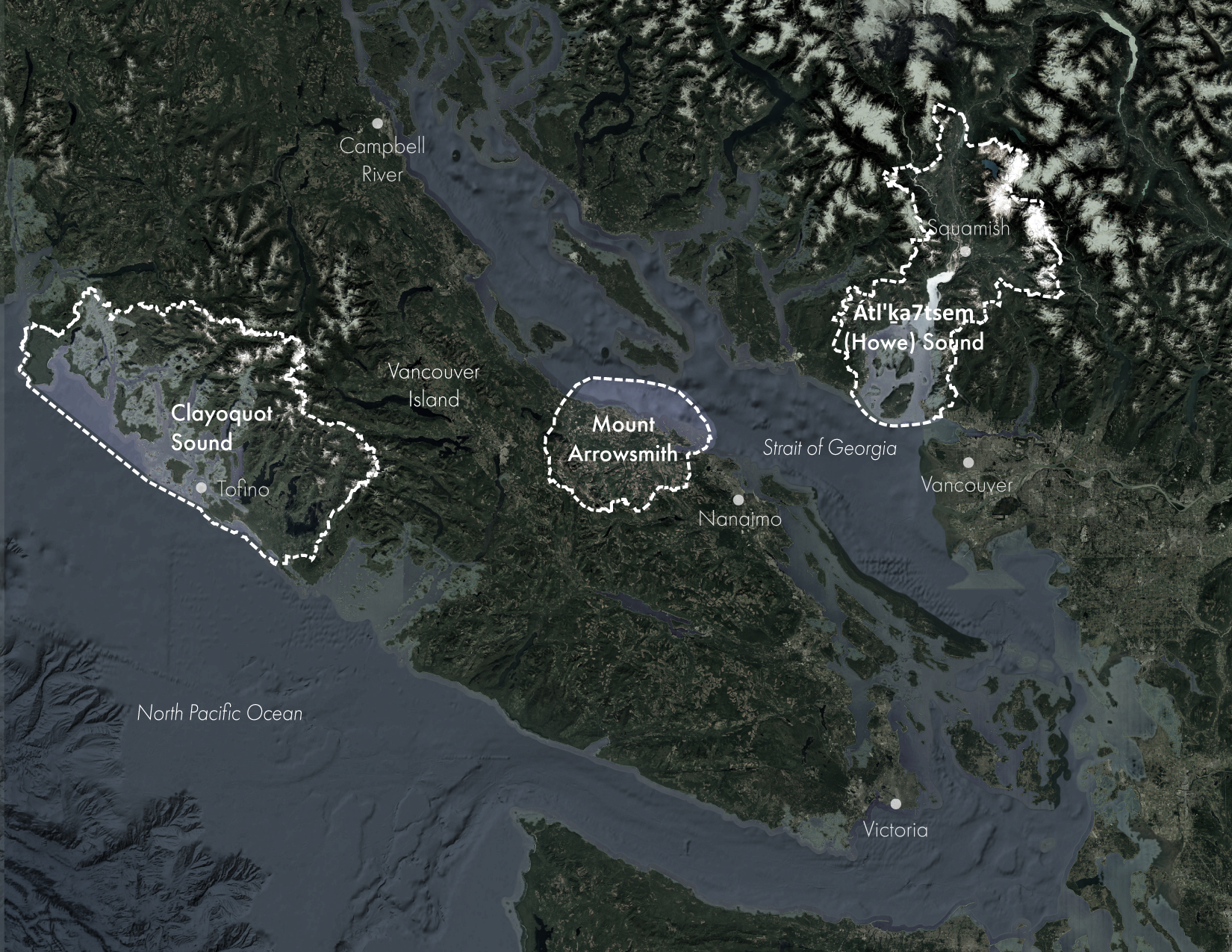
UNESCO Biosphere Regions in British Columbia, Canada
Working on the Clayoquot Sound Biosphere Centre has broadened our understanding of what a UNESCO Biosphere Region actually is.
My first instinct was to think of it as another kind of protected area. A bigger park perhaps?
It isn't.
UNESCO describes biosphere regions as living laboratories for sustainable development - places where conservation, culture, economic activity, research and everyday human life coexist. They include protected core areas, but also buffer and transition areas where people live and work. The designation doesn't create another layer of regulatory authority. Instead, it provides a framework for communities to collaborate across existing boundaries.
That distinction makes British Columbia's three biosphere regions particularly interesting. All operate within the same UNESCO framework, yet each has evolved a different response to its landscape, history and community.
Clayoquot Sound
Designated in 2000, the Clayoquot Sound Biosphere Region stretches across the remarkable coastal landscape of western Vancouver Island — old-growth temperate rainforest, mountains, rivers, beaches and ocean.
Its significance is as cultural and political as it is ecological. Clayoquot Sound's recent history includes intense conflict over forestry, conservation and Indigenous rights. The model that has emerged is therefore deeply connected to collaboration, reconciliation and rebuilding relationships between communities and the land.
The Clayoquot Biosphere Trust supports the UNESCO designation and functions as a community foundation, with priorities extending from conservation to healthy communities, diversified economies, youth, education, knowledge development and good governance. Healthy ecosystems are considered alongside healthy communities rather than as a separate undertaking.
This philosophy is at the heart of the planned Clayoquot Sound Biosphere Centre, which MOTIV has been working on with the Trust. Conceived as a place for education, research, cultural knowledge and community gathering, the Centre will become the infrastructure for collaboration.
Mount Arrowsmith
Travel across Vancouver Island and the model is different.
Also designated in 2000, the Mount Arrowsmith Biosphere Region extends from alpine landscapes through forests and watersheds to the estuaries and marine environments of the Salish Sea. Here, research plays an especially important role.
Since 2014, Vancouver Island University and the City of Parksville have co-managed the region, with the Mount Arrowsmith Biosphere Region Research Institute connecting researchers and students with First Nations, municipalities, conservation organizations, industry and community partners.
This is a working landscape facing urban development pressure and containing substantial privately owned land. The model here is less about drawing a line around nature and more about using shared knowledge to make better decisions within a landscape already occupied and under pressure.
Átl'ḵa7tsem / Howe Sound
B.C.'s youngest biosphere region offers a third model.
Designated in 2021, Átl'ḵa7tsem / Howe Sound extends from mountain peaks to the ocean floor immediately north of Metro Vancouver. It encompasses extraordinary terrestrial and marine ecosystems, including ancient glass sponge reefs, as well as landscapes recovering from decades of industrial impacts.
The watershed crosses First Nations territories, municipalities, regional districts, provincial and federal jurisdictions, conservation areas, private land and working landscapes.
The Howe Sound Biosphere Region Initiative Society has responded with a multi-sector Roundtable, bringing together knowledge holders from First Nations, governments, NGOs, economic sectors, civil society, youth and academia to help guide the region's Nchu'ú7mut/Unity Plan. This common table is particularly important in a region experiencing rapid growth alongside ecological recovery.
Three regions. Three different approaches.
All three protect exceptional ecosystems, but the mechanism isn't simply preservation. It is relationship-building - between science and Indigenous knowledge, communities and governments, economies and ecosystems, and people and place.
As architects, we spend a lot of time working within property lines, zoning boundaries and jurisdictions. But the systems that sustain a place - watersheds, wildlife corridors, food systems, cultures, economies and communities - overlap, blend and transition. One place gradually becomes another while remaining dependent on what lies beyond it.
Perhaps that is the most useful lesson of the biosphere-regions in action: designing for a sustainable future depends on recognizing these gradients and interdependencies, and in maintaining space for discourse, rather than mapping place and people as separate systems with definitive edges.